Thursday, November 12, 2009

Jaipur, Udaipur, Bombay, and Goa

I don't want to sound like a megalomaniac, but if anyone happened to be looking closely at any pics of me, you may have noticed an increasingly shaggy appearance. It had been well over 100 days since my last hair cut (129 to be exact). I finally broke down and got a hair cut - and I lost by beard to a straight blade at the same time. I tell you - there's no feeling like allowing a total stranger to hold a razor to your throat.

before...


and after...


After Agra and the Taj Mahal we breezed through Jaipur. Although not high on the list for most tourists we did go, and I think the best part of it was its ancient observatory, “Jantar Mantar”. It looks more like an architectural playground than an observatory, but when you think about it, that fact shouldn't be too surprising. Hundreds of years ago there were no small instruments like telescopes, astrolabes, etc. The best most civilizations could manage was a sun dial. But here in India, they had built devices to calculate the dates for eclipses, zodiac astrology (one large device for each of the 12 signs), and other strange looking things, like the hollowed out inside of a sphere with all manner of paths inscribed inside it which describe the paths of many stars across the night sky.


The highlight of the observatory was their sun dial. But not just any ordinary sun dial – this one is accurate to within + - two seconds! Wow – that's impressive. How can they get it so accurate? It comes down to size. This monster is 27 meters high! The shadow it casts moves along its dial at four meters per hour. That's the secret to its accuracy.


Jaipur had some of the usual sights (temples, palaces, etc), but it had one surprise for us: rain – something we hadn't seen since the beginning of August – over 100 days ago, and we sure didn't mind the drop in temperature.


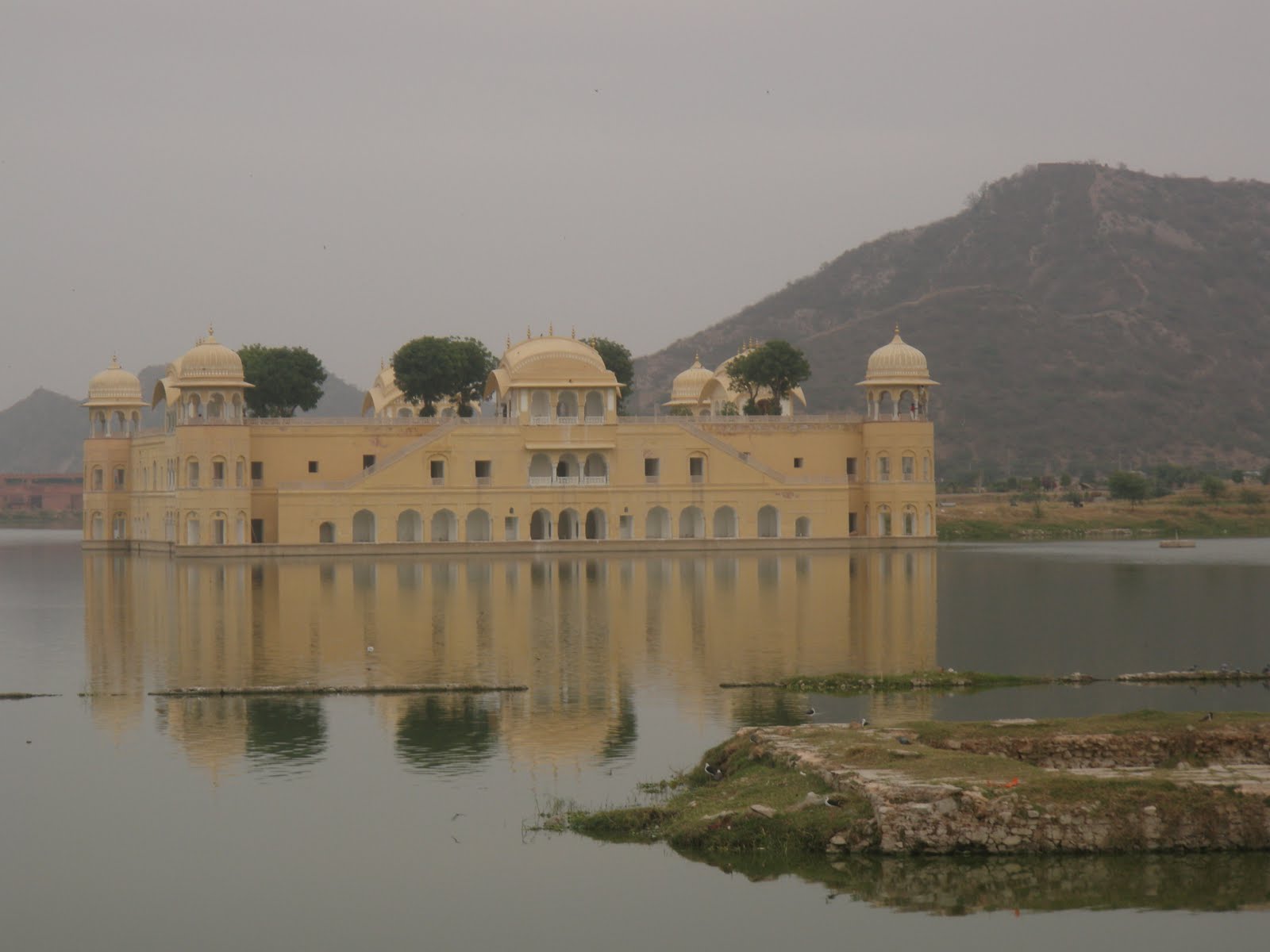
We boarded another night train, and headed a little further south to the very quaint little town Udaipur, famous for its “floating palace”. Of course the palace doesn't actually float – it's built on an island in the lake, but the palace takes up 100% of the island, so it looks like the palace is just floating out there.


It's a sight good enough to attract many tourists – and James Bond as well. This was the location where Bond's “Octopussy” film was made. Our guest house here shows the film every day at 7:30 at its outdoor rooftop restaurant, so we had to watch after having just visited the sights.

In Jaipur we bought train tickets to our next stop. Fortunately, along with the “special” foreigner prices we get to pay, we sometimes get a little better service, such as this special ticket window at the train station. And it looks like Freedom Fighters get this same special treatment...


And then we were in the very quaint little town of Udaipur...


Our method of transport while in most towns is by little three wheeled rickshaws...


One of the fun things we did in Udaipur was go on a horse ride through the countryside.


And then we were off to India's largest city, and unofficial capital, Mumbai (Bombay)...


and we witnessed a bit of India's favorite game – one of the lasting influences from the British colonial days.


We were in Bombay almost exactly one year after the terrorist attacks that held the country in chaos for three days last November. A favorite place where foreigners still congregate is Leopold's bar – just down the road from our hotel. The front window still shows its bullet holes from those attacks – and the owners refuse to replace it so it can bear stubborn witness to the violence they suffered from those gunmen.


By this time we had been in India for about three weeks, and I was pleased that my digestive system was still functioning normally, but that lucky streak came to an abrupt end in Bombay. I got it bad, and spent almost two days holed up in a hotel room. Ugh.

And then we were off to Goa – small towns, beaches, relaxing, and reading.


We had a bit of a reunion with a British couple we'd met in Amritsar, and spent some time with them. We also spent a few days in northern Goa and attended a bit of the International Film Festival of India...


And we decided to take our lives in our hands, and we rented a motorbike and drove about an hour north to Anjuna.


Interesting sights awaited us at this small beach town. Like fancy cows on the beach...


and traditionally dressed gypsy women...


Thursday, November 5, 2009

India: Delhi, Rishikesh, Amritsar, Agra

For us, India started in Delhi, where I was unprepared for the scene that greeted us upon our arrival at the airport there. What I mean is that there were no crowds, no noise and no chaos. It was all calm and orderly. Not at all what we expected, but we managed to sort ourselves out despite being immediately disoriented.

Delhi is a big city with a few famous things to do and see, but only a few days worth, so that's how long we spent there. Among its sights is the Red Fort – so named for the red colored sandstone that so much of it is made from.


Not unique to Delhi (indeed not unique to India) are the ubiquitous auto-riskshaws. This, or the smaller bicycle version are our main mode of transport inside the cities...


In addition to the sights, a big attraction for us to India was the food. Here's a guy in a small shop with a big kitchen - or at least a big pot. I think he could have boiled us both in it...


One of our favorite foods are the sweets called "jalibees". Dough fried and smothered in a delicious syrupy honey. Mmmmm.


As with many poorer countries, the electrical service here is not 100% reliable. I'm not sure if I know why that is, exactly, but maybe there's an electrician reading this blog who can make an educated guess...


And that's not even a bad example of the wiring - just the one I happened to photograph. We've seen about ten times worse.

While in Delhi, we made a visit to India's national museum. I think the most curious thing I saw there was this sign imploring us visitors to kindly NOT give any donations.


I definitely obeyed this sign. Maybe it was intended as reverse psychology?

On a more serious note, we learned a bit about India's famous pacifist leader, Mahatma Ghandi. We visited the residence where he stayed as a guest before being assassinated. It was a very moving exhibit highlighting the life and philosophy of the indefatigable leader. The exhibit culminates with a guided walk along the exact same path Ghandi took while en route to his daily prayers – and there half way to the prayer room is the martyr's pillar - the exact spot where he was murdered. You can see clearly the raised footsteps along the path representing his last few steps.


Personally, I found it a very moving experience.

Next we received an education in the meaning of “luxury coach”. Apparently it means a 1970's era bus that takes half an hour to get started, is over crowded, falling apart, unsafe, has broken seats, and is slow. We paid double price, thanks to the kind people at the travel center, to take this "luxury coach" to Rishikesh. Well, that's where we thought we were going. Even though we (and a few others on the bus) paid to go that far, the driver stopped at Hardiwar (an hour short of Rishikesh) and refused to continue as this is where most passengers alighted. The driver announced he was done for the night. So we shared a rickshaw with some others heading to Rishikesh, and thus completed our 12 hours of luxury travel. Anyway, as I was saying, Rishikesh was our next stop. Known as the yoga capital of the world, it also abounds with related services such as massages, homeopathic therapies, meditation, etc. A very spiritual place – possibly the center of the universe.


The Ganges river flows through the town, and the two sides are joined by two narrow suspension bridges.


We checked ourselves into an ashram and began taking twice daily yoga classes (at least I did – Amanda was under the weather and spent much of her time recuperating instead).

Just to be sure I didn't fall prey to any sort of illness I also subjected myself to some massages. Including this one I'd never heard of before, where they put hot oil into a container and let it pour slowly onto your forehead. The guy constantly refills the container and occasionally give it a push on it's suspension chain to let the drip move side to side. And it worked – I didn't get sick.


Rishikesh is a very laid back town, and true to its Hindu roots the entire place is vegetarian. You can't get meat of any sort. It's no surprise, then, that cows freely roam the streets. And beaches...
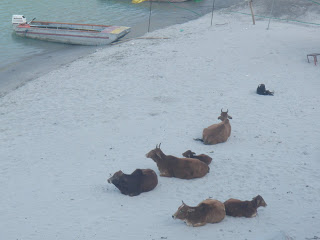


... and the pedestrian bridge...


And bovines weren't the only animals making use of this bridge – a family of monkeys called it home as well. Here's a little video showing these high octane guys having some fun playing around...


Like so many aspects of India, Rishikesh also has its paradoxes. So in addition to being a mecca for yoga, meditation, massage and healing, it is also an adrenaline capital with all sorts of rafting and hiking trips. In fact, there are over 100 rafting companies operating in the small town. At the peak of the afternoon we counted a raft passing by our riverside cafe about once every five minutes. They just pack them in. I was interested in getting wet in the famous Ganges river, so when I learned that one of these companies also offered kayaking trips I jumped at the opportunity.


I used to do a little paddling in a previous life, so I thought what the heck – why not try it again. This stretch of the Ganges river was mostly class 2+ water with a little bit of 3 thrown in for good measure. I remembered how to do my Eskimo roll, but that wasn't enough for the difficult part, so I got my wish and went for a little swim. Fortunately the water was much warmer than how I remembered it in Canada. In fact, the swim was sort of nice.

Believe it or not, the weather during the day was a perfect temperature, which meant that at night things were slightly cool. I had to sleep with a blanket for the first time in months. As I spread the blanket out at night I couldn't help but notice its interesting label...


Just outside of town was a nice nature walk among the steep hills which has a stream that flowed through it, and included many small waterfalls.


I even went for a dip in one of it's many natural pools. Very refreshing in a hot afternoon.

What Rishikesh is perhaps most famous for is that it was here that the Beatles came in 1968 to live for a few months when they studied yoga and meditation under Maharishi Mahesh Yogi at his ashram. It is said that while here, the Beatles received the inspiration for many of the song featured on their White Album. Anyway, Yogi subsequently went to Japan to learn all about feng shuei, and in doing so learned that his ashram was inauspiciously located and on the wrong side of the river so he abandoned the premises, and handed it over to the forestry service. Now dilapidated and unused, the ashram is officially closed and off limits, but if you show up at the locked gate and wait a few minutes, a guard will arrive to tell you it's closed, but he'll gladly accept a few rupees (or a hundred of them) and let you in for a self guided tour. Here's a few pics of the cool two storey huts in the ashram compound.


It was really cool to be there – totally alone – in the place where influential music from the peak of the hippie days was written. All you need is love ......


After Rishikesh we took a train further north (we had learned our lesson about luxury coaches) and journeyed to the city of Amritsar. One really fun thing to do there is to attend the daily border closing ceremony with Pakistan. At the designated hour the gates to the two countries are closed with much fanfare: the guards from each side march menacingly towards each other in a show of mock-intimidation, but in the end they shake hands just before the flags are lowered (at exactly the same time and same speed) and then the gates slam shut. During all this the observers from each side (and there were thousands of us) are shouting "India" or "Pakistan" at the top of our lungs. Meanwhile the national anthems of each nation are loudly played simultaneously, in an effort to out do the other. Every possible aspect of the ceremony is performed by each country in an attempt to improve upon their rival. The guards were exceptionally tall; many of them were over 2 meters! But in a country of one billion people, I guess it's not too difficult to find a few super tall young men to be border guards. Anyway, it was all a lot of fun - and to think this event is repeated daily.

As good as that was, Amritsar is most famous for the Sikh religion's most holy site – the golden temple. Aptly named as its exterior is guilt with no less than 750 kg of solid gold. Wow! Sitting in a pool and accessible only through a walkway, the small temple is beautiful by day or night.

Not in the temple itself, but still inside the walled compound was a free kitchen. Open 24 hours a day, any person from any religion can come here for a free meal. It's very simple - no table or chairs - you sit on the floor beside your neighbor, and the food is scooped out of buckets for free. And it's not just a small token serving of rice - it's a full plate of at least three different items, plus bread and drink. And if you're still hungry just remain seated and when the food buckets come by, you can take as much as you'd like. For free.

An army of volunteers prepare the food, cook it, hand out dishes, collect dishes, wash up, etc. After enjoying a free meal (which tasted fantastic, by the way) Amanda and I went to the washing up pits and did our share of dishes. To get a feel for the magnitude of this operation take a look at this short video. It shows just one of the many stations involved in this effort. This is where used plates are emptied of any remaining food before being washed...


Agra was our next stop - home to the world famous Taj Mahal. Built around 1650 by Shah Jahan, it is a monument of his love for his dearly departed wife. His son, Aurangzeb, was a little less loving, and overthrew his father and locked him up in a prison in Agra fort. When his father said that his only joy in life now was being able to see his Taj Mahal from across the river, his son had him moved to a different room where he could no longer see it.


Consistent with the many paradoxes of India - this beautiful monument exists in one of its ugliest cities.

This accounts for about two of our six weeks in the country. Stay tuned for more as we continue through India...


Friday, October 30, 2009

Istanbul and Dubai

Our travels next took us to fabulous Turkey. I didn't quite know what to expect upon arriving in Istanbul, but I loved it – what a great city. The architecture is just great looking, and the city has genuine character. Among it's most famous sights is the Haghia Sophia...


Once it was a church, then a mosque, and now it is a museum. But what a structure; the pinnacle of which is an enormous self supporting dome in the center. Unlike other cathedrals and mosques, this one is without any supporting columns inside – an amazing feat.

Inside the Haghia Sophia are some ancient tile mosaics like this one....


Just across the street is the equally famous “Blue Mosque”, seen just behind this fountain...


It is so named because of the liberal use of blue in its interior. It really was a stunning building to visit. However, unlike its neighbor across the street (i.e. the Haghia Sophia), the Blue mosque resorts to using four giant "elephant feet" pillars to support the weight of its roof.


Also stunning, but in an entirely different way, was this local favorite...


The label says “hot fermented carrot juice”, but our host here explained that there is a translation error. It is actually spicy fermented raddish juice. Mmmmm. Needless to say, we only bought one of these.

On the opposite end of the “delicious spectrum” were the offerings from the many sweet shops. Now these were good...


Just across from the Blue mosque (and below street level) is an ancient water cistern. A really big one. It is probably an acre or more in size, and for many years held drinking water for the city. At one point it was decommissioned, and subsequently forgotten. Not too long ago it was discovered during construction in the area, and now has been restored for its historical value. It's eerily beautiful down inside. There is a raised walkway through it (because it still holds water about 20 cm deep), and the soft lighting and many columns look very nice. Oh – and it has fish in it too – lots of them.


Typical colors at one of the many cafes


Again, in the same area as the Haghia Sophia and Blue Mosque was the Sultan's residences, known as Topkapi Palace.


The palace grounds are a large walled campus, the hilight of which was the inner sanctum called the harem, guarded and attended to by eunuchs. Not any more – I mean historically - there are no longer any eunuchs at Topkapi.

Inside the palace, the floors, walls and ceilings were elaborately decorated. Ancient Turkey was famous for its ability to produce blue tiles. Here is one of the many mosaics in the harem...


Afterwards we went to a Kurdish restaurant and had a most unusual dessert of candied pumpkin, and candied tomatoes. They were pretty good, actually.


This picture shows Europe on the right and Asia on the left. These two continents are separated here by the Bosporus strait.


We took a nice sight seeing cruise up and down the strait and really got to see what a beautiful city Istanbul is...


Take a look at this nice neighborhood on the banks of the Bosporus. I wouldn't mind to live here...


Istanbul was good to us, and we have fond memories. Thanks also to Dave and Sarah (an American couple who we met on our African safari) for hosting us in Istanbul. Dave is getting his PhD in Turkish history, and so he and his wife Sarah moved to Istanbul for a year, and they kindly put us up in their spare room for our time there.


DUBAI

After Istanbul we went to Dubai for a few days. I must say that in the past I had been a little critical of Dubai, but the city has completely changed my mind. Previously I held the opinion that it was myopic and wasteful of Dubai to be blowing its money on transient things like the world's tallest building, or an indoor ski hill, or the world's largest shopping mall, etc. I felt that their oil riches would be better spent on legitimate infrastructure such as roads, universities, hospitals, etc. Well, after having been there I see they have done that – there's lots of high quality infrastructure (hospitals, airport, schools, metro system, security, etc.) and they're also setting themselves up in other industries to be prepared for the day that their oil dries up. But with all the extra money, they're creating top quality world-attention-grabbing projects, such as the world's tallest building for $4 Billion USD, or a new state of the art F1 race track for $1 Billion USD, etc. These efforts are really getting them noticed. So it's not that these flashy projects are taking money away from the critical items – they're just using their “spare change” to make headlines around the world, and create some awareness. So, after having been there, I admit I was wrong, and I salute the Emir for his micro-nation building strategy.

Although I must say, for all the money they put into the world's tallest building (Burj al Dubai), I thought they could have benefited from a little better quality control...


...or maybe that's just my unsteady hand and a photo-stitch gone wrong. Here's another shot at it...


And just to give it the full perspective, here's a short video clip showing the building in its surroundings.


In general Dubai was fairly western, but it does stay true where it counts. There will be no tolerance for displays of affection...


But indoor skiing is encouraged.


My eye was caught by this cool moving sign at one of the shops...


In all we had just three days or so in Dubai, and we thoroughly enjoyed them. And we were surprised to see that if you try even just a little, it's not hard to conserve cash. E.G. a nice hotel was about $65 CAD per night, the metro cost about $1 CAD, and a reasonable dinner was less than $15 CAD. Of course if you're rich you can easily spend more, but it it's also true that it was not difficult to find reasonable prices for just about everything (except the Ferraris which were costly every where I checked). It was also during our time in Dubai that we reached the half way point on our trip. We're six months in now.


On a closing note, I'd like to say thanks to everyone for your concern over my arms. The surgery in Jordan went fine, and they are healing nicely. They say I might even be able to keep the right arm entirely! ;-)